

Application of DC1000V aR Fuse Links in EV Charging Cabinets
In 2025, we began cooperating with a manufacturer of electric vehicle charging equipment and outdoor EV charging cabinets.
The customer required fuse protection for the high-voltage, high-current DC circuits inside its charging equipment. For this project, we supplied two aR fuse-link specifications for semiconductor protection: the XDRS38MH-400 350A aR fuse and the XDRS51MH-500 500A aR fuse.
Both fuse models are rated for DC1000V applications and are intended to provide , partial-range short-circuit protection for power semiconductor devices and associated DC circuits. The final suitability of a fuse depends on the complete circuit design and protection coordination.
Project Overview
|
Item |
Project Details |
|
Customer |
Manufacturer of EV charging equipment and outdoor charging cabinets |
|
Cooperation started |
2025 |
|
Application |
DC circuit inside an EV charging cabinet |
|
Fuse model 1 |
XDRS38MH-400 |
|
Rated current 1 |
350 A |
|
Fuse model 2 |
XDRS51MH-500 |
|
Rated current 2 |
500 A |
|
Rated voltage |
DC1000V |
|
Fuse class |
aR |
|
Installation method |
Bolted directly to the high-current DC busbars |
|
Protection purpose |
short-circuit and semiconductor protection |
Customer Product: Outdoor EV Charging Cabinet
The customer manufactures outdoor charging cabinets for electric vehicle charging systems.
These cabinets integrate DC busbars, power conversion components, switching devices, monitoring equipment, control systems and circuit protection devices into a complete charging power system.
Our Fuse Solution
We supplied two aR fuse specifications for different charging-cabinet current requirements.
|
Model |
Rated Current |
Rated Voltage |
Fuse Class |
Main Application |
|
XDRS38MH-400 |
350 A |
DC1000V |
aR |
DC circuit and semiconductor protection |
|
XDRS51MH-500 |
500 A |
DC1000V |
aR |
DC circuit and semiconductor protection |
The two models allow the customer to select a suitable fuse according to the current rating, circuit design and protection-coordination requirements of each charging-cabinet configuration.
Installation in the DC Busbar System
The fuse links are installed directly in the DC busbar circuits inside the charging cabinets.
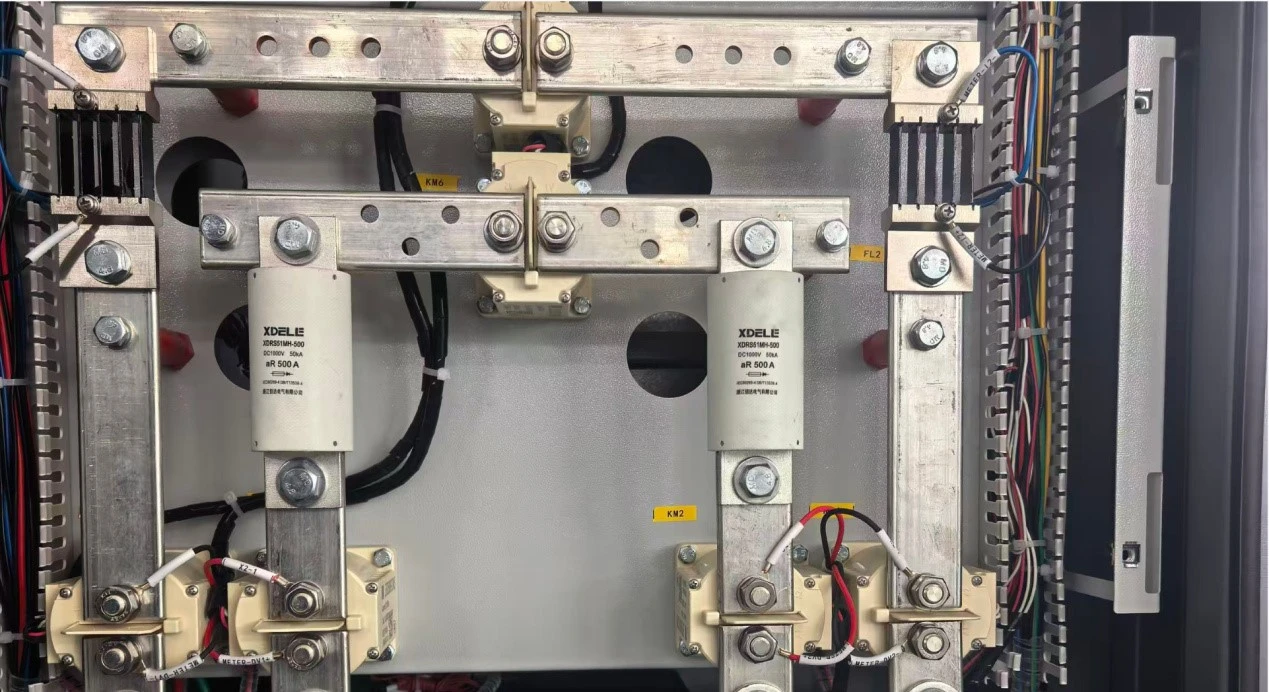
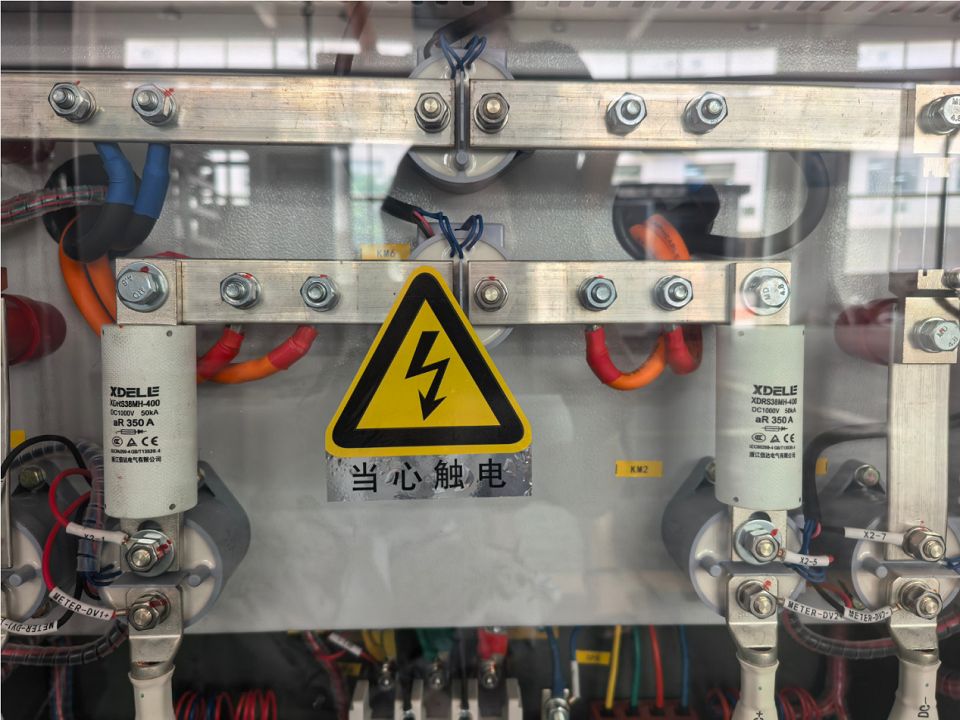
Each fuse is secured between conductive busbar sections using bolted connections. This installation method provides a compact current path and allows the fuse to be integrated into the cabinet's existing power-distribution structure.
The installation photographs show:
- Two XDRS38MH-400 350A fuse links installed in one cabinet configuration.
- Two XDRS51MH-500 500A fuse links installed in another cabinet configuration.
- Bolted connections at both ends of each fuse link.
- Direct connection to the cabinet's high-current DC busbars.
- Fuse links installed in the cabinet's high-current DC power paths.
- Accessible positioning for inspection and replacement.
Correct busbar alignment, clean and suitable contact surfaces, manufacturer-specified tightening torque and temperature-rise control are important for maintaining a stable electrical connection at the fuse terminals.
Why aR Fuses Are Used in EV Charging Equipment
An aR fuse is a partial-range fuse link intended primarily for short-circuit protection of power semiconductor devices and associated electrical circuits. It is not a full-range overload-protection device.
When a severe fault occurs within the fuse link's specified operating range, the fuse can operate rapidly to limit fault duration, peak current and let-through energy. Proper coordination can help reduce the electrical and thermal stress imposed on power semiconductor devices and associated DC components.
When properly selected and coordinated, the fuse can help reduce the risk of a severe short-circuit fault damaging additional components or propagating to other parts of the charging system.
Project Value
The two DC1000V fuse solutions provided the customer with flexible protection options for charging cabinets with different current requirements.
The project demonstrates several practical advantages:
- Fuse options for both 350A and 500A cabinet designs.
- Compact installation inside the charging cabinet.
- Replaceable protection components for equipment maintenance.
- Protection coordination with power semiconductor circuits.
The final fuse selection for each cabinet must be based on the complete electrical design rather than rated current alone. The fuse-link rated voltage must be suitable for the maximum circuit voltage, and its breaking capacity must be verified from the applicable product datasheet and test documentation and be adequate for the prospective short-circuit current at the installation point.
Information Required for Fuse Selection
For a new EV charging cabinet or DC charging-pile project, the following information should be considered:
- Maximum DC operating voltage
- Normal operating current
- Prospective short-circuit current
Fuse coordination and installation should be confirmed by qualified electrical engineers using the applicable product data, semiconductor protection requirements and complete system design. Compliance of the finished EV charging equipment cannot be established by the fuse alone.
Need a DC Fuse for an EV Charging Cabinet?
Send us your DC voltage, operating current, prospective fault current, semiconductor information and installation dimensions. Our team can help identify a suitable fuse specification for your application.
Contact us to request technical data, samples or a quotation.
Phone/whatsapp
Jacob: +8618968770800
Email: admin@xindaele.com